A Week in the Wilderness
Some fishing trips transcend the fishing. You remember the people, the setting, the culture, the time with Dad. But the fishing… that was amazing.
This is the story of eight days chasing giant trevally, spot tail bass and the legendary Papuan black bass on New Britain, one of the most remote corners of the planet.
Day 1: A Monster on the Reef
We started out of Liamo Reef Resort in Kimbe, run by Baia Sportfishing. The resort sits right by the sea, overlooking a string of reefs — so naturally, that’s where we began. They didn’t disappoint.
Dad opened the score sheet with a big bluefin trevally. I missed a GT early on, but bounced back with a red bass, my first ever. Then, unbelievably, still on day one, I hooked the biggest fish of the whole trip: a massive GT. A second one followed soon after.
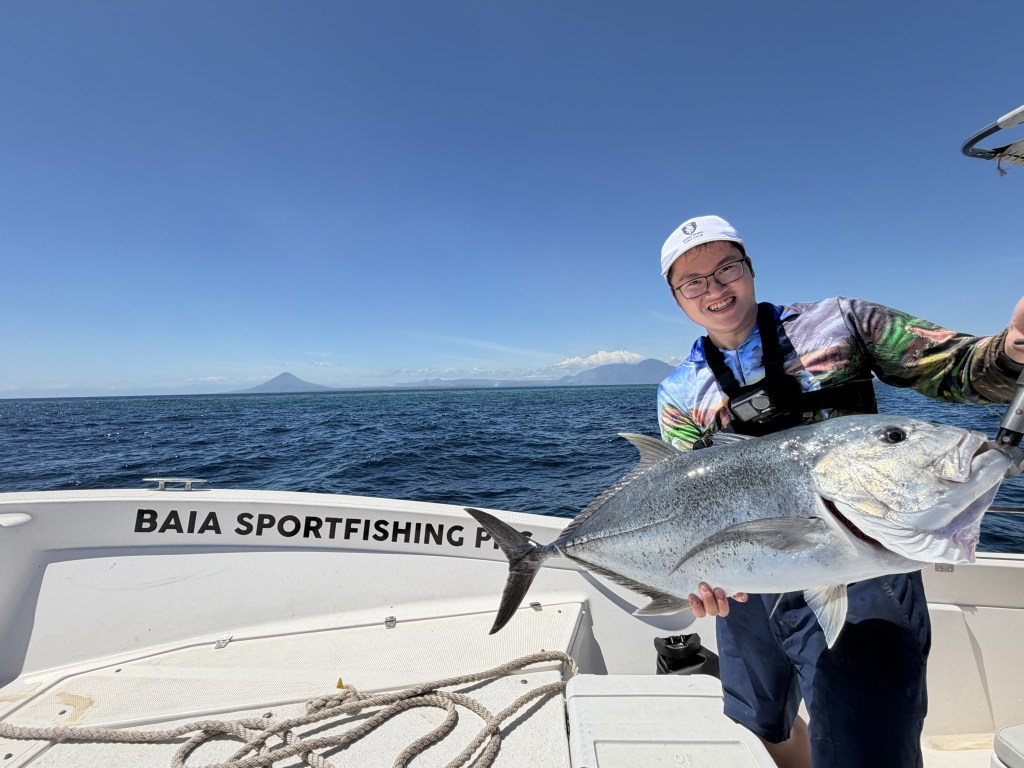
In the afternoon we headed up a river to target black bass and spot tails. We didn’t find either, but we did land a baby GT, which we gave to the local kids.
That moment is one of my favourite memories of the trip. The boy I handed it to took one look at his friends, hugged the fish to his chest and sprinted off down the beach. Clearly not wanting to share the credits for catching it with his friends.
Day 2: Into the River
On day two we switched things up and fished a river in the morning, still out of Liamo, before meeting the mothership Ultimate One to head to Baia.
What I really appreciated about Baia Sportfishing is how closely they work with the local villages. On the way to the river we picked up a member of the local tribe, who holds rights over that water, and brought him along.
Our friends on the trip, Grant and his father — two Texans — were with us too. When we landed, the villagers ran straight across the beach to greet them. I suspect they may have been some of the first white people these locals had ever seen. My dad and I, being Chinese, drew rather less attention, perhaps unsurprising, since when I landed in Port Moresby every sign was in English and Chinese.
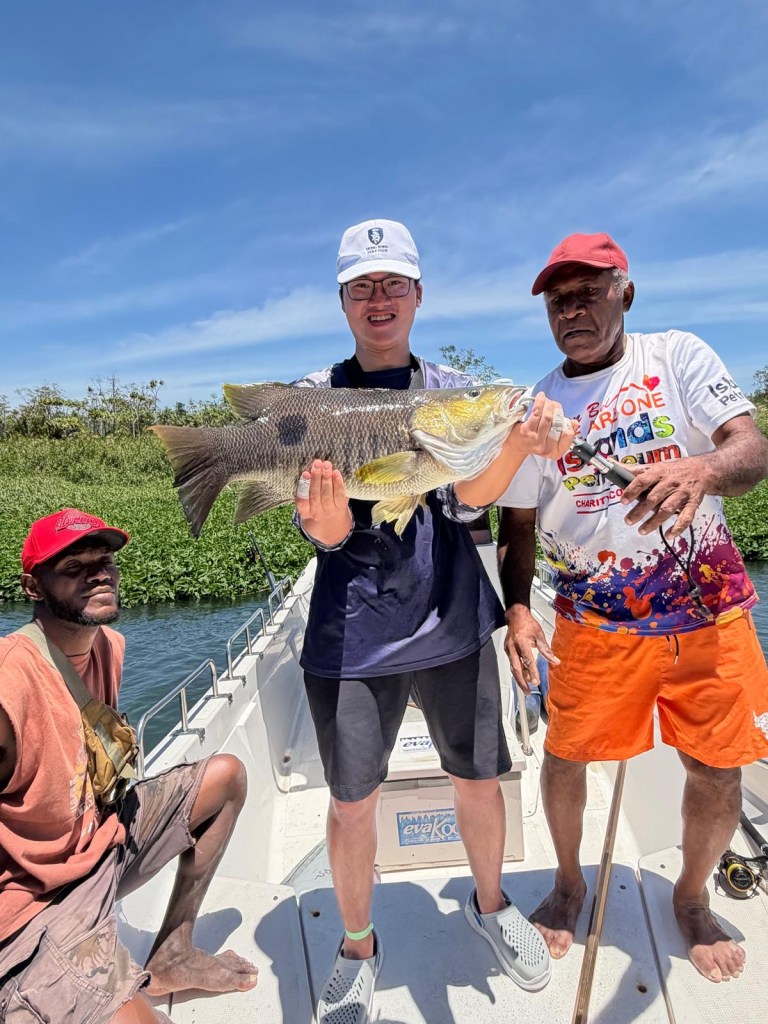
Then came the biggest spot tail of the trip. I spotted a snag along the bank, put in a good cast, and three seconds later — smash. The fish bolted straight under a log and I was sure it was gone. But the boat driver gunned the engine and pulled us clear, I held on, and after a proper fight we landed it.
Day 3: Paradise, Tarpon and a Fifteen-Foot Croc
Before the fishing, I need to pause on just how beautiful this place is. Picture a small island, New Britain, in one of the most remote places on Earth. Volcanic peaks rise on the horizon. You’re deep in the jungle, casting under mangrove trees so enormous you wouldn’t believe they were mangroves, with banana trees towering overhead. Apart from the odd village, there’s not a soul in sight — just untouched wilderness, crystal-clear water, and species I’d never seen before. And the sunsets… Being out on the water as the sky lit up was something else.

Back to the fishing. We opened day three with two misses on Indo-Pacific tarpon. You could watch them follow and smash the lure, but when I set the hook I’d sometimes foul-hook them instead — and neither stayed on. Such is life.
A move to a new river livened things up. We landed a 62 cm spot tail bass, just shy of the previous day’s fish. Then we saw it: a crocodile at least fifteen feet long, body out of the water, tail curled beneath the surface. You don’t want to go swimming there.
In the afternoon another spot tail came out of a snag, and I missed one more tarpon. I’ve still never caught one. But what a day it was.
Day 4: The Peak of Papua New Guinea Fishing
If one day captured fishing in Papua New Guinea at its best, it was day four, on a new river called the Toriel.
We started by finding schools of whitebait along the shore with fish blowing up on them. I grabbed my fly rod and cast a small two-inch imitation. Suddenly small GTs came charging in, I strip-set, and I was on — my first GT on the fly. We pulled three out of that spot.
Further upriver, we found what we’d come for. We were casting along a rock bank while some local kids watched and laughed at us — all this gear and technique, and nothing to show for it. Then my lure got hit, and it was a Papuan black bass. Dad soon followed with one of his own.
Further still, we hit a snag that seemed to hold endless spot tails. In about eight to ten casts I caught six. None were big, but nobody complains about a numbers day.
That day also taught me how temperamental these rivers are. Over a ten-hour day, there might be one hour when the fish bite consistently. The rest is cast, retrieve, repeat. We came to believe four factors decided it: snags, shade, the tide and the moonrise.
If you are interested in following along this adventure, check out my vlog:
Days 5 and 6: Quiet Water and a Sunset Save
After the madness of day four, day five was quiet. We chased whitebait along the shore again but couldn’t get a bite. We did meet a smaller croc, maybe five or six feet. What struck me was how fast it vanished: even with polarised glasses, once it sank a foot or two it was simply gone. Eerie, when you think how many you’ll never see.
Just as I thought I’d be skunked, I caught a GT in the same spot where I’d landed the black bass the day before.
Day six was another slow one. I tried baitcasting for the first time and loved it, though everything that could go wrong did. The topwater bites I got were frustrating: fish would explode on the lure and miss it, again and again. Our friends saw the same. I think it shows both the aggression and intelligence of these fish. They strike to kill whatever’s invading their patch, not necessarily to eat it.
Then, just as a second skunk loomed, a GT came to the rescue while we cast off the beach, into the sunset, the tide rolling in, volcanic mountains behind us. It doesn’t get much better than that.
If You’re Planning the Trip: Safety, Flights and Lodges
When I signed up, I had little idea what I was getting into, so here’s what I wish I’d known.
Safety. Tell people you’re going to Papua New Guinea and they ask whether you’ll be eaten or caught up in tribal warfare. In reality, once Baia Sportfishing picked us up at Hoskins, everything was safe, smooth and extremely well organised. I never felt in danger in Kimbe, at Liamo or at Baia.
Flights. The weak link is the small-plane connection between Port Moresby and Hoskins. Flights get delayed, cancelled or rearranged, which can strand you overnight in Port Moresby. Our flight out was fine, but other guests got stuck, and our return was cancelled, so we had to leave a day early. If that happens, stay in an airport hotel and don’t wander the city alone. We did exactly that on our last night, and it was safe and pleasant.
Lodges. Both lodges were spectacular, looking out over reefs, sea and jungle. You can watch fish and turtles from the shore. It isn’t a five-star hotel, but for a fishing trip it was comfortable. Baia has a lovely lounge where the eight of us swapped fishing stories each evening.
Food. Outstanding. I loved the local kumu greens, picked from the river, and the seafood came straight out of the sea. You can’t beat that.
All in all, it put every worry I had to rest.
Day 7: The Village, and What It Taught Me
On day seven we visited a local village. After hearing the villagers’ songs and watching their cultural dances the night before, it was moving to see how they live.
I’ve lived in Hong Kong and Oxford, massive and historic cities. Baia village was very different, the tallest building was one or two storeys. Houses were built from wood and local materials, raised on stilts against the floods of the wet season. Many windows had no glass. The only villages I’ve seen that were simpler were the mud houses of the Masai Mara in Kenya.
Then there were the children’s toys, made from banana leaves and seashells. All trip, whenever we gave something away, a fish, a toy, clothes, the joy and gratitude was evident.
It made me ask what’s gone wrong in our developed, consumerist societies. We buy the latest phone, the newest toy, the next app update. We say a polite thank you, feel a flicker of happiness when we hit “buy”, and within days it’s forgotten in a cupboard. We keep buying, believing more things will make us happier, yet we seem to have less joy and less gratitude than ever.
It reminded me of Thorin’s words to Bilbo in Tolkien’s The Hobbit: “If more of us valued food and cheer and song above hoarded gold, it would be a merrier world.” I think he was right. If we moved past consumerism and valued the simple things — human relationships, love, care for one another — it would be a merrier world.
Subscribe for more newsletters on fishing and philosophy:
The Final Days, and Why I’d Go Back
Our last river session was a half day, one final shot at spot tails and black bass. Like the days before it, the morning was quiet, so we motored back to the Ultimate One and returned to Liamo. On the final morning we fished the reef one last time before heading to the airport for Port Moresby.
We didn’t land a trophy black bass or spot tail, but we caught plenty of both. We added new species, including barracuda and red bass. And we had three massive GTs — the beach fish especially. That first-day GT was a proper tank; nothing has pulled that hard on my line in a long time.
Would I go back? In an instant. I still want that trophy black bass. But if we fished only for giant fish, we’d be disappointed far more often than not. The real reward is the place, the people, the scenery and the culture — and the time to reflect on life.
What stays with me most is what I said at the start: the memories with Dad, the friends we made, and a way of life I’d never seen. For a fishing trip somewhere truly exotic, Papua New Guinea is hard to beat.
Even now, lying in bed back home in Hong Kong, I can close my eyes and still hear the hymns those children sang. That is something I won’t forget.
Leave a Reply